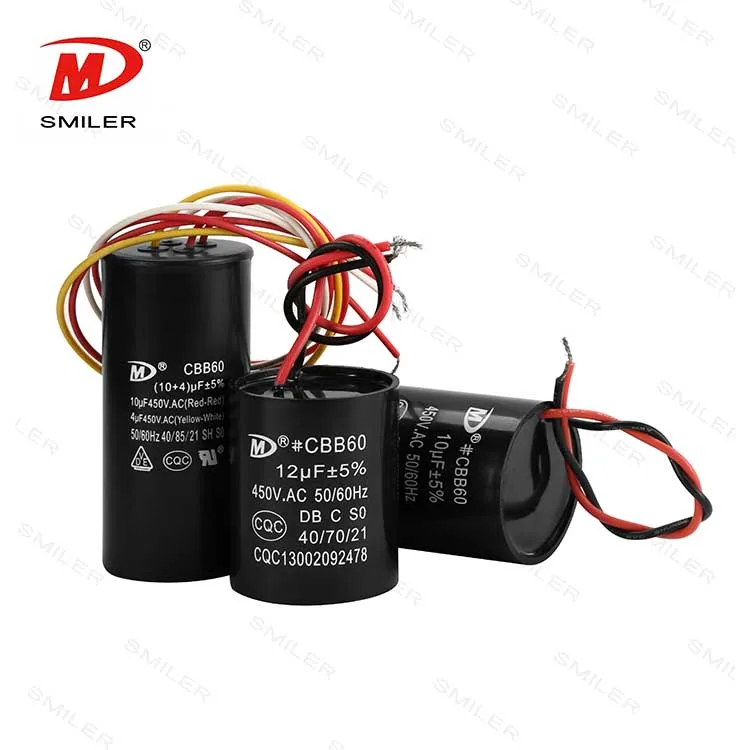
Motor applications and construction
CBB60 applications include washing machines, shutter motors, range hoods, paper shredders and water pumps. Its wound metallized polypropylene construction is described as non-inductive and self-healing. The filling has a UL94 V-0 material description; this is distinct from a finished-product approval.
For an appliance project, start with the motor specification and the space available for the capacitor. State whether the application is starting or running duty and include the required connection arrangement. The appliance examples describe intended uses; they do not identify a universal replacement part for every motor.
Electrical specification choices
The series is specified for 110–600 VAC at 50/60 Hz, with J (±5%) and K (±10%) capacitance tolerances. The published dissipation-factor limit is 0.0020 at 100 Hz. A terminal-to-terminal test of twice rated voltage for three seconds is listed separately from the normal AC voltage rating.
The catalogue also lists steady-state operation at 1.1 times rated voltage and 1.3 times rated current. These are separate stated conditions. Do not treat them as permission to combine every maximum in an equipment design; include the actual voltage and current requirements in the enquiry for the selected configuration.
Temperature and operating-life classes
Three climatic categories are listed: 40/70/21, 40/85/21 and 40/105/21. The operating-life options are class A at 30,000 hours, class B at 10,000 hours and class C at 3,000 hours. Safety classes are listed from S0 to S3. Specify the class your project requires rather than assuming the longest life or highest class applies to every CBB60.
Where your equipment approval requires a particular certificate, state its name and destination market. Request the current document and applicable model scope with the proposal. The class selections and approval requirements should be linked to the part you intend to buy.
Package examples for layout review
The technical table gives a 10-microfarad, 450 VAC example with a 35 mm body diameter and 65 mm height. At 20 microfarads and 450 VAC, the listed body is 44 mm in diameter and 65 mm high. These are separate catalogue examples, useful for an initial space check.
Before fixing the assembly drawing, request the complete outline and terminal details for your chosen rating. Mark any limits on height, diameter and mounting position. SMILER also invites enquiries for additional sizes and parameters; a custom enquiry should describe the required configuration rather than assume that a pictured package is the final design.
Compare related products and request a quotation
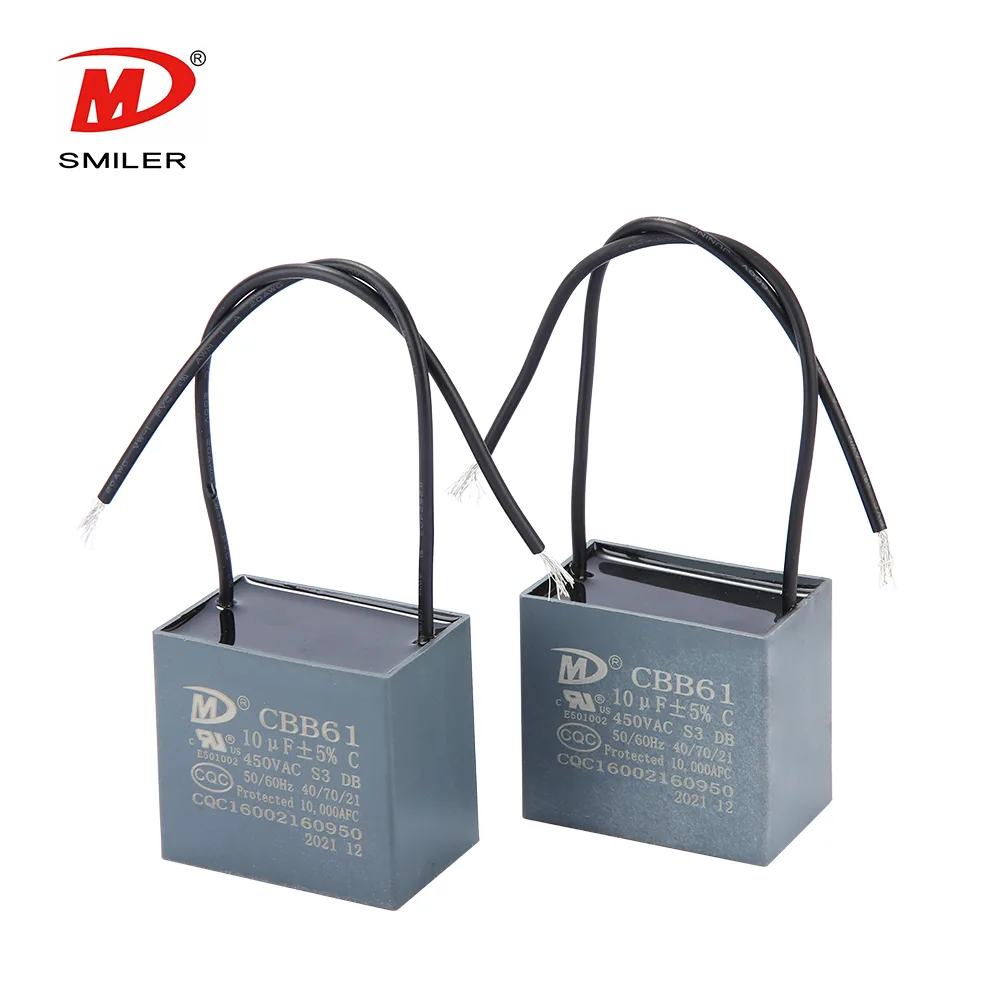
Browse the CBB capacitor range for other motor-capacitor families. The CBB61 capacitor is another catalogue option to review against your application requirements, rather than an automatic substitute for CBB60.
For a quotation, send capacitance, tolerance, AC voltage, frequency, intended duty, temperature requirement and the required life and safety classes. Add the drawing, sample quantity and expected production demand. Our capacitor RFQ checklist provides a concise starting point.
Frequently asked questions
What materials are used in CBB60?
The series uses metallized polypropylene film, a plastic or aluminium shell and resin filling. Include your preferred shell construction in the enquiry.
Is every CBB60 rated for 30,000 hours?
No. The catalogue lists A, B and C operating-life classes at 30,000, 10,000 and 3,000 hours respectively. Confirm the class of the proposed part.
Can I select a replacement by the CBB60 name alone?
Use the motor requirement, electrical marking and mechanical drawing together. The family name does not specify capacitance, voltage, terminal arrangement or operating class.
Sources & technical reading
Product information is based on the SMILER catalogue. Confirm the specification for the selected configuration.