A capacitor for fan and ventilation projects
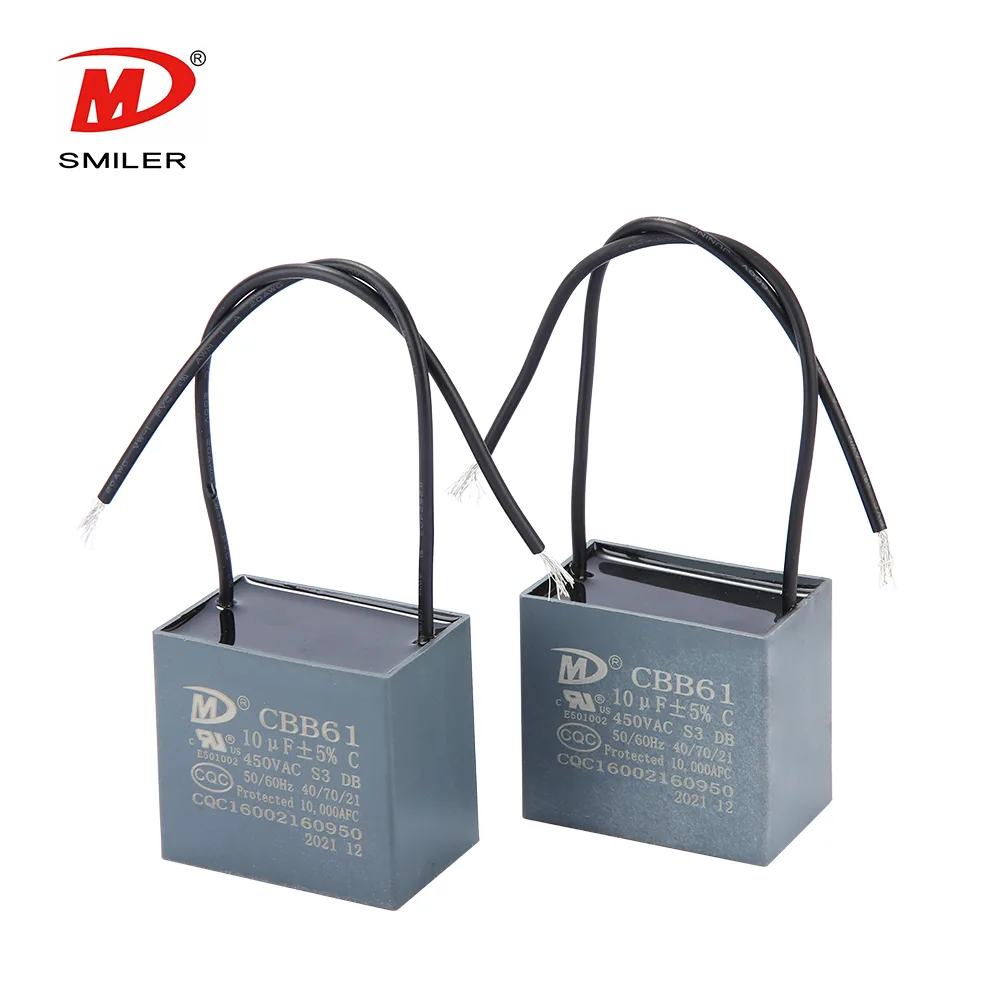
SMILER lists CBB61 for single-phase motors supplied at 50/60 Hz. The wound film construction is non-inductive, and the series features include self-healing behavior and low loss. The resin filling is described as UL94 V-0 material. This material description should not be mistaken for a complete appliance certification.
For a fan or air-purifier project, provide the motor specification and identify the capacitor position in the circuit. Include the mounting space and connection details with the electrical requirement. If several equipment variants use different motors, give each required capacitor configuration its own enquiry line.
Electrical specification choices
The series is specified for 110–600 VAC at 50/60 Hz, with J (±5%) and K (±10%) capacitance tolerances. The published dissipation-factor limit is 0.0020 at 100 Hz. A terminal-to-terminal test of twice rated voltage for three seconds is listed separately from the normal AC voltage rating.
The catalogue also lists steady-state operation at 1.1 times rated voltage and 1.3 times rated current. These are separate stated conditions. Do not treat them as permission to combine every maximum in an equipment design; include the actual voltage and current requirements in the enquiry for the selected configuration.
Temperature and operating-life classes
Three climatic categories are listed: 40/70/21, 40/85/21 and 40/105/21. The operating-life options are class A at 30,000 hours, class B at 10,000 hours and class C at 3,000 hours. Safety classes are listed from S0 to S3. Specify the class your project requires rather than assuming the longest life or highest class applies to every CBB61.
Write the required life and safety class beside the electrical rating on your request. A proposal can then be evaluated against those specific requirements. If a certification document is required for the destination market, identify it in the enquiry and ask for the applicable model scope.
Check the enclosure against a specific rating
At 450 VAC, the table lists a 1.0-microfarad part at 36 × 10.5 × 20 mm and a 2.0-microfarad part at 36 × 15 × 25 mm, in length × width × height order. These examples show why the body outline needs to accompany the electrical rating when planning an appliance assembly.
Treat the dimensions as catalogue examples for those combinations. Request the proposed part drawing with terminal or lead details before fixing mounting provisions. If the available space differs from a listed outline, send the permitted envelope and explain which dimensions are fixed. Additional sizes and parameters can be discussed as a customization enquiry.
Request a CBB61 quotation
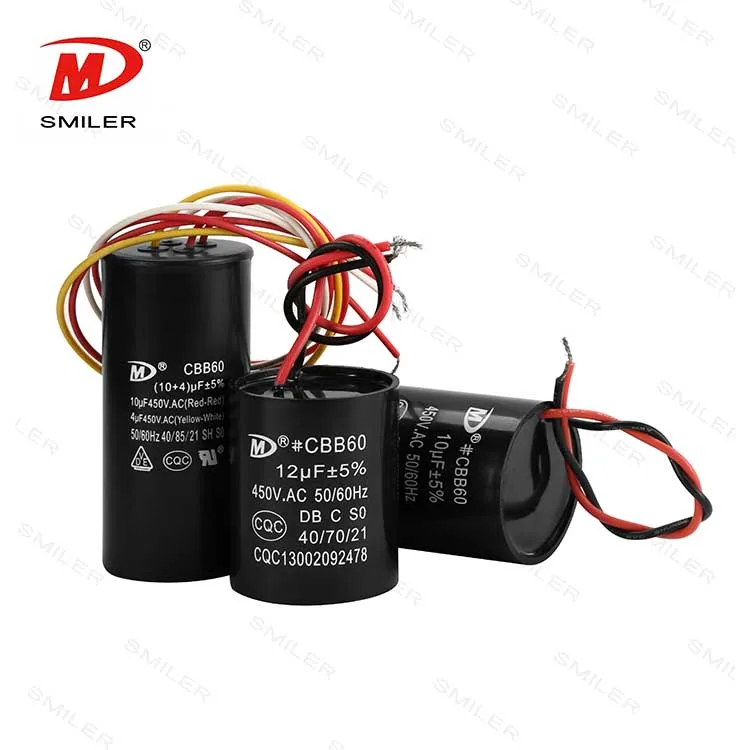
Compare the CBB capacitor range to see the related motor-capacitor families. CBB60 has a separate catalogue description and package options; a shared motor application does not settle whether it is suitable for your assembly.
Send the required capacitance and tolerance, AC voltage, frequency, intended duty and local temperature requirement. Add the life and safety classes, equipment drawing, sample quantity and production demand. The capacitor RFQ checklist can help organize these details before you request a quotation.
Frequently asked questions
What housing does CBB61 use?
CBB61 is specified with a plastic shell and resin filling around metallized polypropylene film. Request the outline for the chosen rating.
Which equipment applications are listed?
The series is listed for fans, ventilators, air purifiers and AC motor starting and running applications. The actual motor specification should lead selection.
Does the series name define the life class?
No. The catalogue lists A, B and C operating-life options, together with S0–S3 safety-class options. Confirm the selected classes for the proposed part.
Sources & technical reading
Product information is based on the SMILER catalogue. Confirm the specification for the selected configuration.