DC-link capacitor ripple current needs a set of conditions, not just an ampere value. Before comparing suppliers, check what the number describes: the current waveform, frequency, temperature and cooling arrangement. This guide helps OEM engineers and buyers review that evidence and prepare questions for a film capacitor manufacturer. It does not supply a universal current limit or approve a component for your equipment.
Start with the capacitor duty, not the equipment label
An inquiry that says only 'capacitor for a solar inverter' leaves the reviewer with too much to guess. Identify the capacitor's circuit position, the operating modes under review and whether your requirement describes one component or a bank. Keep the converter output current separate from the current specified at the capacitor. Ask the designer to label each value before it enters the purchasing comparison.
Use the broader DC-link capacitor selection guide to organize voltage, capacitance and physical constraints. The narrower task here is to make the ripple-current evidence usable. A buyer should be able to trace every quoted current capability to a proposed part and a documented set of conditions. If that connection is missing, keep the item open rather than recording a technical pass.
Read the conditions beside the ripple-current rating
Open the proposed part's specification and collect the current definition, reference frequency, temperature definition and cooling assumptions in one place. Record the document revision as well. Ask whether the figure is continuous RMS current, a pulse-related limit or another characteristic. Those descriptions should stay attached to the number when it is copied into a comparison sheet.
Do not treat a catalogue rating as an unconditional allowance. TDK's film capacitor overview explains that ripple and high-frequency currents cause self-heating. It also distinguishes AC and DC voltage ratings. Passing a voltage requirement therefore does not, by itself, answer your thermal question. Request the selected part's applicable limits instead of extending a general description into a specific approval.
Ask for the current spectrum and applicable ESR data
Frequency belongs in the review. TDK's CLARA documentation describes ESR and RMS-current curves against frequency, and its thermal simulation requires a harmonic spectrum. This provides a useful reason to ask for more than a single total-current figure. The documentation concerns TDK models; it is not a source of SMILER characteristic curves.
For your inquiry, request the available waveform or frequency breakdown from the design team. Label measured and calculated data separately. Include the operating mode and explain any gaps in the record. If the supplier gives an equivalent series resistance value, ask which frequency, temperature and part configuration it represents. Keep that answer beside the value, rather than moving the number into a generic 'low ESR' column.
Leave the loss assessment to the responsible engineer using an applicable model. Ask which parts of the supplied spectrum the assessment covers and whether any conditions sit outside the documented data. This is a review question, not an instruction to extrapolate a curve. A missing frequency range is something to resolve with the supplier before releasing the part.
Separate ambient, case and internal temperature
A temperature entry needs a location. Identify whether it describes enclosure air, the capacitor case or an internal temperature estimated by a model. Also record the equipment mode and the basis of the value. Do not relabel a convenient surface observation as a verified internal limit. Ask the supplier which temperature definition its specification uses and how your available evidence should be compared with it.
Murata's film capacitor characteristics guide connects self-heating with both current conditions and the surrounding temperature, and points to the film element's internal temperature as a design constraint. For a purchasing brief, the consequence is straightforward: submit the electrical duty alongside the thermal information. An ambient value alone leaves part of that discussion unanswered. No Murata temperature limit is transferred to a SMILER product here.
Check whether the cooling assumptions match the assembly
TDK states that its CLARA self-heating estimates use laboratory conditions with a single capacitor and natural cooling, without other heat sources. It recommends evaluation in the actual application. Treat this as a reminder to read model boundaries, not as evidence that every manufacturer's rating uses the same setup.
Prepare a simple description of your assembly for the supplier: enclosure, nearby components, capacitor arrangement and intended cooling. Attach the relevant layout when available. Ask which differences from the rating conditions need further assessment. If a fan, enclosure or component position changes during development, flag the revision to the engineer rather than assuming the previous review still covers it.
Keep cooling requirements visible in the approved specification. Purchasing should know whether an offer depends on a particular installation condition. Otherwise, an apparently equivalent replacement may arrive with assumptions that the assembly team never received.
Review operating modes and evidence gaps before samples
Create a short list of operating modes for the design team to assess. For each one, request the available voltage, current, frequency and thermal information, together with its duration or duty description. Ask the engineer to identify the governing cases. Avoid choosing a single 'worst case' yourself from the largest number in unrelated columns.
Then separate what is known from what still needs evidence. A useful review record names the missing information, the person responsible and the decision it blocks. For example, an offer may be ready for a physical-fit sample while its thermal suitability remains unresolved. Record that distinction explicitly. A sample order should not silently become permission to release the component into production.
Have the qualified engineering team define the application evaluation and acceptance criteria. This article does not provide energized testing or measurement instructions. Its purpose is to make the evidence request clear enough that the eventual approval refers to the intended component and equipment configuration.
Keep series identity separate from proven current capability
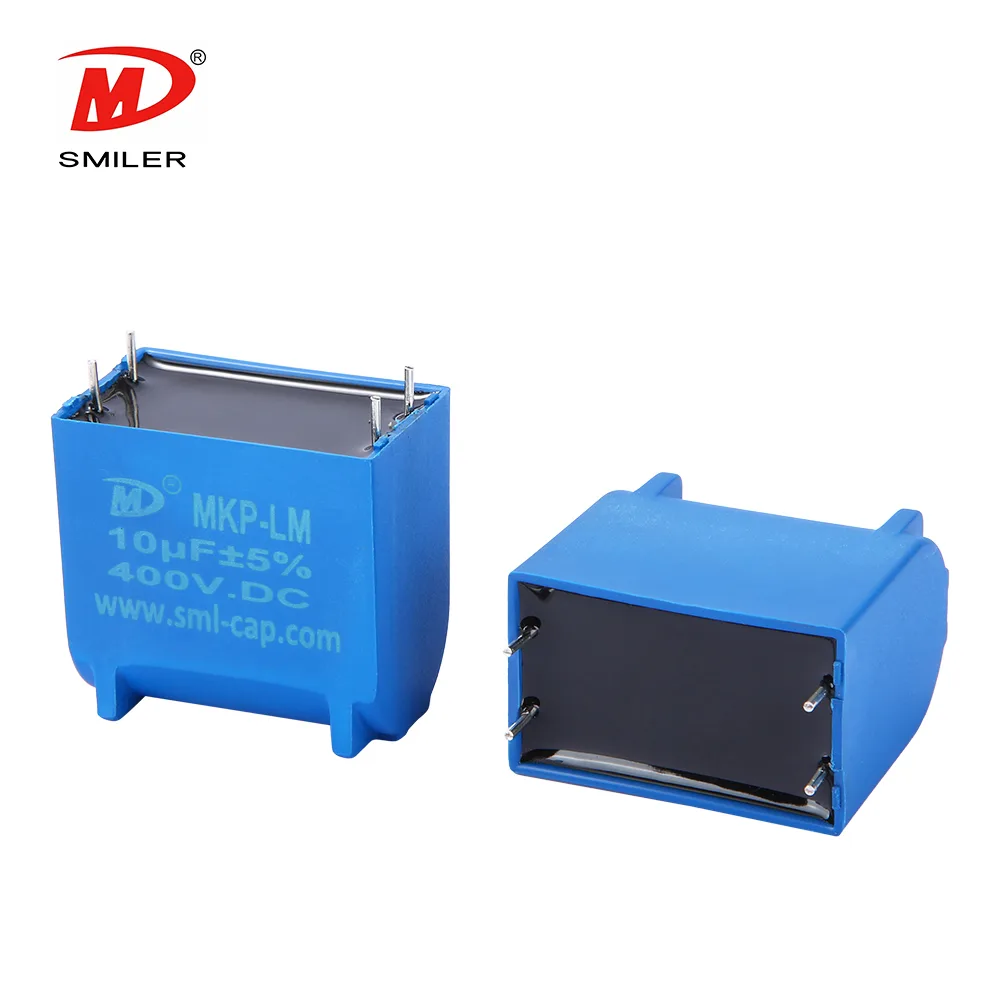
The SMILER DC-link capacitor range includes MKP-LM and MKP-LM THB. The MKP-LM product page describes a metallized polypropylene film series in a plastic housing, with listed applications including frequency converters and solar inverters. These catalogue facts help you choose a starting point for an inquiry. They do not establish the permissible ripple current in your assembly.
For MKP-LM THB, the catalogue specifies a humidity exposure lasting 1,000 hours, with rated voltage applied at 85°C and 85% relative humidity. It also gives acceptance limits: capacitance change within 10% and insulation resistance at least 50% of the initial limit. These conditions describe the humidity test; they do not show a ripple-current advantage over another series. Use the electrical data for the proposed configuration when assessing current loading, and request the relevant test documentation. TDK or Murata guidance explains general principles rather than establishing a SMILER rating.
Turn the review into a supplier question that can be answered
Send the supplier a consistent brief: capacitor position, proposed quantity and arrangement, electrical requirements, available waveform or spectrum, temperature definitions, cooling description and mechanical outline. Ask for the proposed part identification, the applicable characteristic data and any conditions that remain unverified. Include the required sample and production quantities so the technical discussion supports a useful quotation.
The capacitor RFQ checklist covers the wider purchasing and documentary requirements. For this review, finish with a specific request: confirm which supplied operating conditions the proposed part can be assessed against, identify missing evidence and state the next technical decision. Compare quotations only after those answers are visible. A larger current number with undisclosed conditions is not enough to choose an alternative.
Frequently asked questions
Can I select a DC-link capacitor by ripple current alone?
No. Review the current under its stated conditions alongside voltage, capacitance, thermal limits and the mechanical interface. The selection guide covers that wider task; this article focuses on making the ripple-current evidence comparable.
What should I send if I only know total RMS current?
Send the known value with its source and operating mode, and mark the frequency information as unresolved. Ask the design team and supplier what additional waveform or spectrum data is needed. Do not invent a frequency to complete the form.
Does a THB series name confirm higher ripple-current capability?
A series name is not sufficient evidence. Ask for the exact configuration's electrical characteristics and relevant test documentation. Compare the documented conditions rather than interpreting the suffix as a current rating.
Sources & technical reading
- www.tdk.com — 8
- www.tdk-electronics.tdk.com — clara
- www.murata.com — feature
- www.smlcapacitor.com — DC Link MKP LM THB Type
Product information is based on the SMILER catalogue. Confirm the specification for the selected configuration. External technical references explain general principles, not SMILER ratings or approvals.